Hybrid Insulators
Silicone × Ceramic
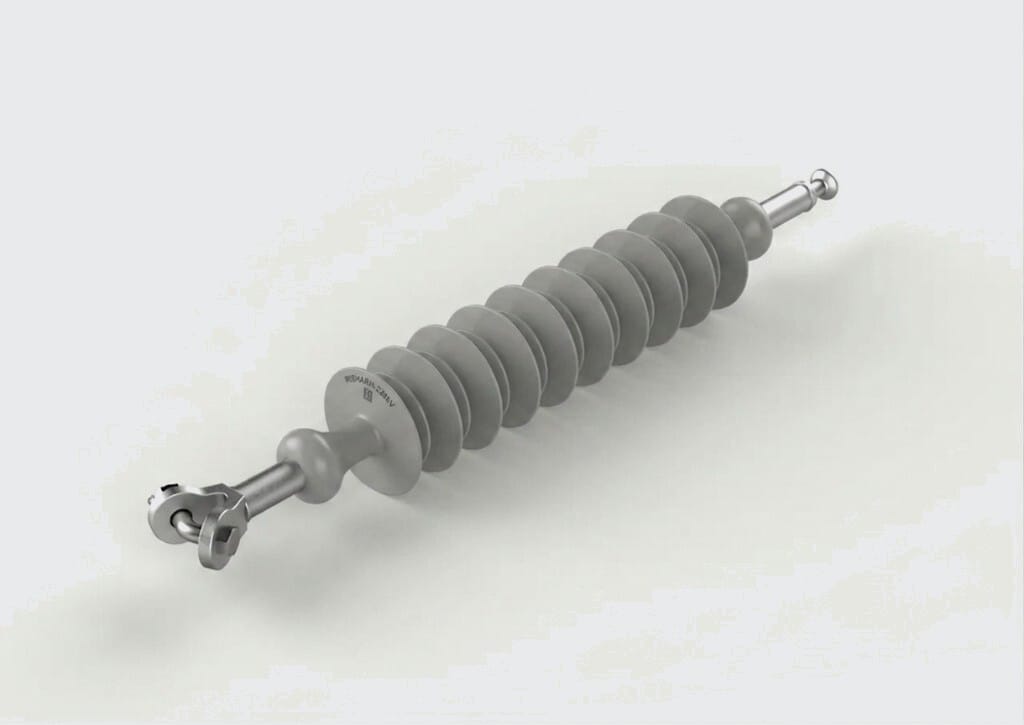
Patented composite construction that combines a silicone housing with a porcelain or glass body. Delivers the mechanical resilience of ceramic with the hydrophobic, self-cleaning performance of silicone.
Loading
Blog – R&D
Taban Niroo’s Research & Development team focuses on the design and development of products that deliver additional value under demanding electrical and environmental conditions. Our work is guided by IEC standards and continuous feedback from the field.
R&D overview
Every Taban Niroo product begins as a calculation, not a guess. Our R&D team works from IEC standards, electrical field simulations, and years of accumulated field data to engineer insulators that perform reliably in the specific conditions they'll actually face — not just in laboratory ideal conditions.
This approach has driven two of our most significant engineering efforts: rigorous, standards-based shed profile design for our composite insulator range, and the development of our hybrid insulator technology — a product line we've been refining since 2009.
Pollution performance engineering
Shed profile design isn't a matter of aesthetics — it's a set of precise engineering parameters that determine how an insulator performs under real-world pollution and moisture conditions. Our R&D team calculates every long rod insulator design against the full set of IEC/TS 60815-3 criteria, including:
Profile criteria
Verifying shed overhang differences meet the standard's thresholds for effective self-cleaning.
Ensuring shed geometry avoids the risk of shed-to-shed arcing.
One of the most critical checks in profile evaluation, since insufficient shed spacing can negate the benefit of added creepage distance entirely.
A localized check against arc bridging in deep, narrow sections of the profile.
Balanced to allow effective natural washing without compromising creepage performance.
A global density check confirming the overall design meets pollution severity class requirements across SPS Class a through e.
Each of our long rod insulator designs is verified against every one of these parameters before production — not just tested after the fact. This calculation-first approach is what allows us to confidently specify our products for the heavy pollution, coastal, and desert environments common across our served markets.
Hybrid insulator development
Taban Niroo was one of the first manufacturers to design and manufacture hybrid line post and pin-type insulators, in use since 2009. Hybrid insulators combine a porcelain core — delivering the mechanical strength, rigidity, and long-term dimensional stability porcelain is known for — with a silicone rubber housing, delivering the pollution resistance and hydrophobicity that porcelain alone cannot offer.
Conventional porcelain insulators are strong but pollution-vulnerable and prone to brittle failure. Standard composite insulators are lightweight and pollution-resistant but can't always match porcelain's mechanical rigidity under bending, torsion, and compression loads. Hybrid insulators are engineered to combine both — without the compromises of either technology alone.
Our R&D team spent more than a year developing our original hybrid line post and pin insulator design, using electrical field simulation to optimize field distribution and minimize partial discharge risk around end fittings. That work has since been extended to hybrid solid-core station post insulators — engineered for HVAC air-insulated substation applications up to 420 kV, with electrical field analysis confirming safe field distribution at the critical fitting interfaces.
Our hybrid post insulator design has passed the full range of electrical and mechanical type tests required under existing composite and porcelain post standards, along with long-term natural ageing and pollution performance testing. In Iran, hybrid insulator technology is recognized under a national standard developed by researchers at the Niroo Research Institute (NRI) — the same technical foundation reflected in the international IEC/TS 62896 standard specifically developed for hybrid insulators.
Several of our hybrid post insulator installations are in service at 420 kV AC substations across a range of environmental conditions, and continue to perform reliably without the need for regular washing — a direct result of the pollution-resistant silicone housing combined with a mechanically robust porcelain core.
In short, our hybrid insulators offer
Patents & Innovation
Innovations developed in-house, registered, and already deployed on live transmission and distribution networks.
Silicone × Ceramic
Patented composite construction that combines a silicone housing with a porcelain or glass body. Delivers the mechanical resilience of ceramic with the hydrophobic, self-cleaning performance of silicone.
Pollution-zone retrofit
Field-installable silicone booster sheds that increase the creepage distance of existing porcelain or glass insulators, eliminating flashover risk in heavily-polluted substations.
MV–HV transformers
Polymer-housed transformer bushings with a silicone weather-shed system engineered by Taban Niroo for medium- and high-voltage power transformers.
Articles & field notes
2 Aug 2026
Power networks in coastal, industrial, and desert regions face a shared enemy: contamination. Salt spray, industrial dust, cement particles, and airborne pollutants settle on insulator surfaces over…
29 Jul 2026
Creepage distance is one of the most important — and most frequently underestimated — specifications in insulator selection. Get it wrong, and even a well-manufactured insulator can fail prematurely…
25 Jul 2026
Choosing between composite and ceramic (porcelain or glass) insulators is one of the foundational decisions in transmission and distribution line design. Both technologies remain in active use…
21 Jul 2026
As power networks push into more demanding environments — higher pollution zones, more extreme weather, longer spans — insulator technology has continued to evolve beyond standard composite designs.…
17 Jul 2026
Every insulator design involves tradeoffs. Maximize mechanical strength and you may compromise on weight or pollution performance. Optimize for weather resistance and you may need to reinforce…
13 Jul 2026
Transformer bushings are among the most critical — and most historically overlooked — components in a substation. They're the interface where high-voltage conductors pass safely through a…
9 Jul 2026
Transformer outages are expensive — in lost capacity, emergency repair costs, and in some cases, cascading impacts on grid reliability. While transformer failures can stem from many causes,…
5 Jul 2026
Wherever an underground or enclosed cable system connects to an overhead line, that transition point is handled by an outdoor termination — and it's one of the more electrically stressed components…
1 Jul 2026
Cable joints are unavoidable in any extensive underground network — cable comes in finite manufactured lengths, and every connection point needs a joint engineered to restore the cable's original…
27 Jun 2026
Overhead distribution feeders are exposed to a constant stream of transient risks — lightning strikes, tree contact, equipment failure, animal contact, and more. Cut-out fuses are one of the most…
23 Jun 2026
Not every insulator performance problem requires a full replacement. When an existing installation is experiencing flashover issues due to insufficient creepage distance for its actual environmental…
19 Jun 2026
Coastal and desert environments sit at opposite ends of the humidity spectrum, but both present some of the most demanding conditions an insulator will ever face. Understanding the specific stresses…
15 Jun 2026
IEC standards get referenced constantly in insulator specifications and datasheets, but it's worth stepping back to understand what these standards actually cover — and why the distinction between…
11 Jun 2026
Insulator specification is sometimes treated as a relatively simple exercise: match the voltage class, pick a standard product, move on. In reality, climate and pollution conditions should be one of…
7 Jun 2026
Across much of Africa, the Middle East, South America, and other emerging markets, power infrastructure is undergoing significant expansion and modernization — driven by rising electricity demand,…